7.9
Loading…
Guidance for runners who roll in, without giving up the cushioning.
Softer DNA Loft v3, a lower 10 mm drop and GuideRails you barely notice.
“The same quiet stability, with more foam where your forefoot wanted it.”
A protective, stable all-rounder with a rock shield and TrailTack rubber.
“The sensible hiking-boot-adjacent choice for rough, technical terrain.”
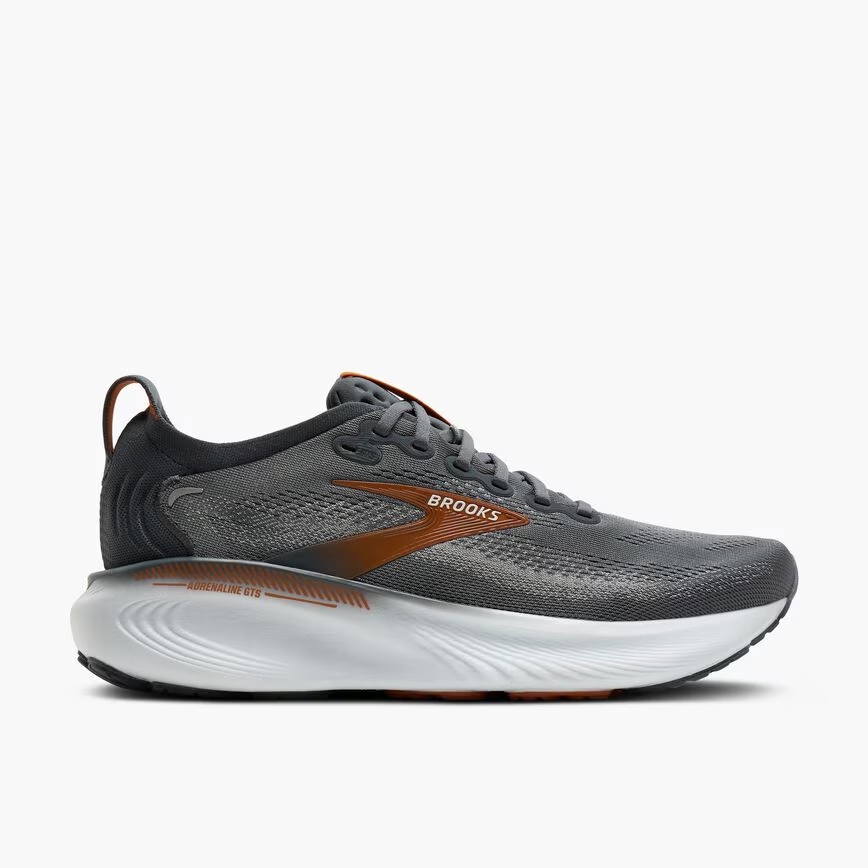
GuideRails keep your knees honest without a hard medial post.
“The stability shoe that's been quietly right for twenty-four versions.”
Low-slung, locked-down and precise, with a rock guard for technical ground.
“Mountain-goat footing for scree, roots and anything with a cliff edge.”
Guidance without the brick-like posting of stability shoes past.
“Stability for people who swore they'd never wear a stability shoe.”
Brooks's tallest stack yet, with a rocker to keep it rolling.
“A lot of shoe. Some days that's exactly what you want.”
A broad, stable base and a rocker, made for walking days as much as running ones.
“The cushioned, no-surprises pick for new runners and long walks.”
A stability running shoe guides a foot that rolls inward further than most after it lands. Older models did it with a hard wedge of firm foam under the arch, called a medial post. The shoes on this page mostly do it more quietly: a wider base, foam shaped to cradle the heel, or raised sidewalls like Brooks's GuideRails that only engage when your foot tips too far. The aim is a shoe that feels steady, not one that pushes your foot around.
You don't need one just because a treadmill video says you overpronate. Pronation is normal, and research on whether rolling in causes injury is mixed. Try a stability shoe if your ankles visibly cave in, if your shoes wear through on the inside edge first, or if your knees or arches ache late in long runs. If one feels steadier and nothing hurts, it's working.
Mild overpronation rarely needs the most supportive shoe on the shelf. A lighter-touch stability shoe, one that relies on a wide base and midsole shape rather than a firm post, is usually enough. Some neutral shoes with broad, steady platforms do a similar job for runners who only roll in a little. Save the firmest guidance for runners who roll in a lot, or whose form fades when they're tired.
Expect some weight. The road stability shoes here weigh 280 to 305 g, against 215 to 292 g for our neutral daily trainers. Drops run higher too, from 6 to 12 mm, which suits heel strikers. If you want more cushion and a lower drop, the max-cushion stability picks stand on stacks of 40 mm and more, with 6 mm drops.
Off road, stability comes from a firm, wide platform and a secure fit more than from posts or rails. The trail picks here are built that way, with 6 to 8 mm drops for steadier footing on rough ground.
Every shoe on this page carries the stability flag in our catalog and a Runsletter Score out of 10 from our testing. Sort by score or price, or add two or three to compare side by side. Our overpronation guide in the Journal goes through each pick in more detail.